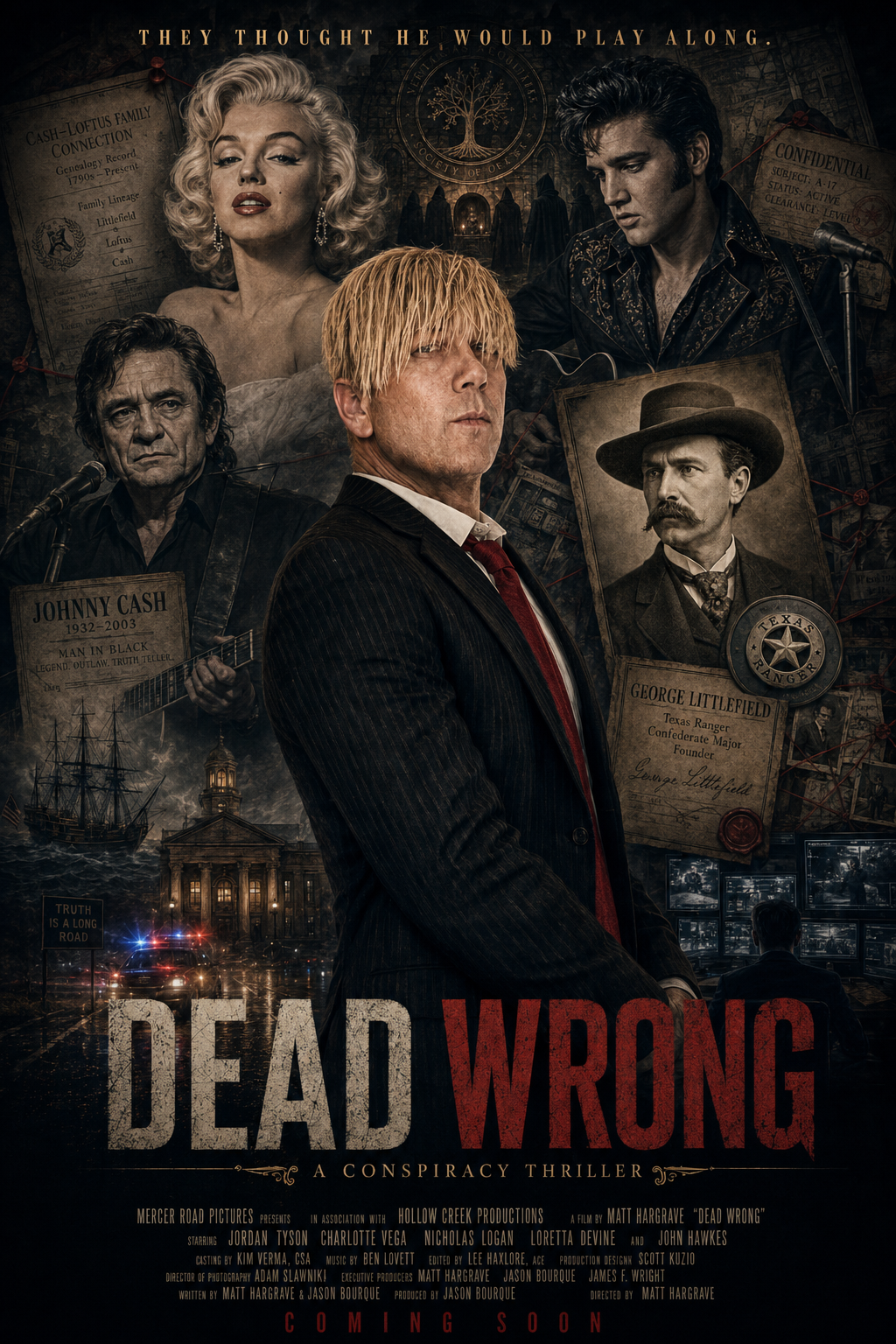
DEAD WRONG
Movie Concept
Genre: Conspiracy Thriller / Psychological Drama / Mystery
Tagline:
They tried to study him. They never expected him to remember who he was.
Logline
After being lured into the Deep South under false pretenses by the hidden CIA, operating through AI they placed inside of people and actual CIA agents themselves trying to blendis as if they were a victims too. a gifted man from an extraordinary American family line begins to suspect that his arrest, isolation, and separation from his family are pieces of a covert experiment involving secret societies, behavioral manipulation, genealogy, and a hidden effort to exploit everything encoded in his bloodline.
Short Synopsis
Prince Jordan Tyson is not an ordinary man.
Haunted by a lifetime of strange manipulation, betrayal, surveillance, and unexplained coincidences, Prince begins connecting the dots after being drawn into Mississippi by circumstances that initially appear accidental.
But nothing is accidental.
Once there, Prince finds himself surrounded by people who seem to know more about him than they should. A sheriff with deceptive charm. Local power brokers operating behind respectable institutions. Mysterious observers appearing at crucial moments. People entering his life at precisely the right — or wrong — time.
What begins as confusion slowly transforms into a terrifying possibility:
Prince may not have been luered, brought South merely to be arrested.
He may have been brought there to be studied.
As Prince digs deeper, he uncovers whispers of a fictional off-the-books operation descended from the darkest philosophies of Cold War behavioral experimentation.
Its architects believe personality, talent, courage, charisma, rebellion, leadership, and even artistic ability can echo through generations.
Their obsession is genealogy.
Their laboratory is America itself.
And Prince is their ultimate subject.
THE GOLDEN CHILD
Hidden inside the operation’s archives is a designation reserved for an extraordinarily rare kind of subject:
THE GOLDEN CHILD.
According to the CIA experimenters’ theory, Prince represents one of the most genealogically concentrated subjects they have ever encountered — a living convergence point where generations of American history, artistic talent, military service, frontier courage, celebrity mythology, and old family bloodlines appear to intersect.
In the mythology of the film, researchers become obsessed with the possibility that Prince’s extended ancestry carries echoes of families associated with legendary American figures.
Elvis Presley.
Marilyn Monroe.
Johnny Cash.
A celebrated Texas Ranger.
A legendary United States Marine.
A distinguished United States Navy legacy.
Old American pioneers.
Colonial families.
And ancestral lines reaching backward toward European nobility and royal houses whose descendants crossed the Atlantic and helped populate the emerging United States.
To the scientists running the project, Prince is not simply another person.
He is a nucleus of inherited potential.
A concentration of talent.
A convergence of bloodlines.
A living archive.
They believe generations of music, charisma, survival instinct, leadership, physical resilience, intelligence, rebellion, beauty, creativity, and courage have converged in one individual.
Their internal files give him another name:
THE AMERICAN NEXUS.
Prince sees it differently.
He calls it family.
And that is exactly what the experimenters never understand.
They can chart ancestry.
They can collect DNA.
They can record behavior.
They can manipulate environments.
But they cannot manufacture loyalty.
They cannot reproduce love.
And they cannot understand why one person would risk everything to protect the people from whom that inheritance came.
The conspiracy therefore develops a terrifying objective.
They do not merely want to understand Prince.
They want to separate him from everything that makes him powerful — and take it for themselves.
THE SOUTHERN EXPERIMENT
Prince discovers evidence suggesting that the operation deliberately returned selected descendants to geographic regions connected to their ancestral past.
The theory is almost unbelievable.
Centuries ago there were no surveillance cameras, psychological profiles, digital records, DNA databases, or behavioral analytics.
But now there are.
The experimenters believe that if descendants carrying similar family traits are placed into environments once inhabited by their ancestors, researchers can observe their decisions under comparable pressures.
Would courage repeat itself?
Would rebellion?
Would musical talent?
Would leadership?
Would violence?
Would loyalty?
Would genius?
Could history somehow echo through blood?
Prince becomes the centerpiece of the experiment.
Mississippi becomes the laboratory.
His life becomes the control group.
THE TRAP
Prince comes to believe he was selected for several interconnected purposes:
To observe him.
To psychologically pressure him.
To study his reactions.
To manipulate his relationships.
To isolate him geographically.
To separate him from his children and family.
And eventually, perhaps, to exploit his reproductive potential and DNA.
The operation attempts to surround him with distractions: relationships, seduction, manufactured conflicts, legal trouble, intimidation, and carefully constructed coincidences.
Then comes the most effective weapon of all.
The law.
A sheriff enters the story.
Prince initially believes she is simply another official caught inside a corrupt system.
Eventually he begins wondering whether the opposite is true.
What if appearing to be the obvious villain is precisely what makes someone invisible?
What if the operation is using reverse psychology?
Nobody would believe something so blatant could actually be intentional.
Prince is arrested.
Charged.
Restricted.
Separated.
And held inside the very territory the experimenters want him to remain in.
What looks like ordinary criminal justice from the outside begins looking very different from inside the experiment.
To Prince, it becomes kidnapping under color of law.
DIVIDE AND CONQUER
The operation understands something Prince considers even more dangerous than physical captivity:
family separation.
If Prince remains close to his children and relatives, he can warn them.
He can identify recurring faces.
He can recognize manipulation.
He can compare stories.
He can tell them who appeared around him before.
So the experimenters apply one of humanity’s oldest strategies:
Divide and conquer.
Keep Prince isolated.
Place observers near other family members.
Allow everyone to experience only one fragment of the larger pattern.
Nobody sees the entire picture.
Except Prince.
And that makes him dangerous.
THE LEGACY PROJECT
Then Prince uncovers the darkest layer of the operation.
The researchers are no longer satisfied with studying history.
They want to recreate it.
Their files contain references to cultural icons whose lives became inseparable from the mythology of the American South.
Elvis Presley.
Johnny Cash.
Marilyn Monroe.
The project asks an outrageous question:
What if extraordinary talent is not entirely accidental?
What if the correct combination of ancestry, environment, psychology, trauma, opportunity, and genetics could produce another cultural phenomenon?
The conspirators begin studying descendants and extended family networks.
They compare photographs.
Voices.
Musical ability.
Temperament.
Physical characteristics.
Charisma.
Behavior.
DNA.
They attempt to lure relatives into areas connected with the birthplaces and formative environments of legendary performers.
Their ambition is no longer merely scientific.
It becomes industrial.
Recreate the talent.
Own the discovery.
Control the next legend.
Prince realizes that members of his family may have been valuable to the project without ever understanding why people suddenly entered their lives.
Some may never realize they were being observed.
Others may have been manipulated without recognizing the pattern.
But Prince recognizes it.
WHY THEY FAILED
The architects of the experiment make one catastrophic mistake.
They believe genealogy determines destiny.
They believe environment determines behavior.
They believe psychological pressure eventually breaks everyone.
They believe enough surveillance can predict every decision.
They believe Prince will eventually surrender, cooperate, or simply accept the reality they construct around him.
They are wrong.
Prince’s greatest inheritance is not celebrity.
It is not nobility.
It is not appearance.
It is not talent.
It is not even DNA.
It is the one quality their laboratories cannot reproduce:
the refusal to surrender.
They believed they had discovered the Golden Child.
What they actually created was the one witness capable of recognizing the experiment.
Now hunted, isolated, and desperate to protect the people he loves, Prince must outthink a system specifically designed to make him appear irrational whenever he gets too close to the truth.
Every discovery creates another question.
Every ancestor opens another door.
Every attempt to silence him reveals another piece of the architecture.
And ultimately Prince understands why they worked so hard to separate him from his history.
They wanted his inheritance.
They wanted his talent.
They wanted his bloodline.
They wanted his family.
They wanted his story.
They wanted everything that generations before him had created.
And they believed they could simply take it.
Because they thought they could control Prince Jordan Tyson.
They thought he would play along.
They thought they had chosen the perfect subject.
They were dead wrong.
Tone and Style
A dark, sophisticated conspiracy thriller blending Southern Gothic mystery, psychological warfare, genealogy, American history, celebrity mythology, surveillance culture, and family drama.
The audience should constantly question what is coincidence, what is manipulation, and what Prince has genuinely uncovered.
The visual world moves between rain-soaked Southern highways, courthouses, surveillance rooms, genealogical archives, historic photographs, DNA laboratories, old mansions, churches, secret meetings, military records, family portraits, and enormous ancestry charts connecting generations.
Main Character
Prince Jordan Tyson — intelligent, charismatic, observant, stubborn, emotionally scarred, fiercely loyal, and extraordinarily difficult to control.
The conspirators view him as a biological asset.
Prince views himself as something much simpler:
A son.
A father.
A descendant.
A survivor.
And a man determined to protect his family history from anyone who believes it belongs to them.
Themes
-
Bloodlines, inheritance, and identity
-
The exploitation of genealogy
-
Talent versus genetics
-
Psychological warfare
-
Surveillance and manipulation
-
Family separation as social control
-
The ownership of history
-
Celebrity mythology
-
Nature versus nurture
-
Institutional power
-
Loyalty and betrayal
-
Survival against systems designed to rewrite reality
-
The difference between studying a human being and understanding one
Poster Lines
THEY TRIED TO STUDY HIM.
THEY NEVER EXPECTED HIM TO REMEMBER WHO HE WAS.
HE WASN’T BROUGHT SOUTH BY ACCIDENT.
HE WAS CHOSEN.
THEY THOUGHT THEY KNEW HIS BLOOD.
THEY WERE DEAD WRONG.