
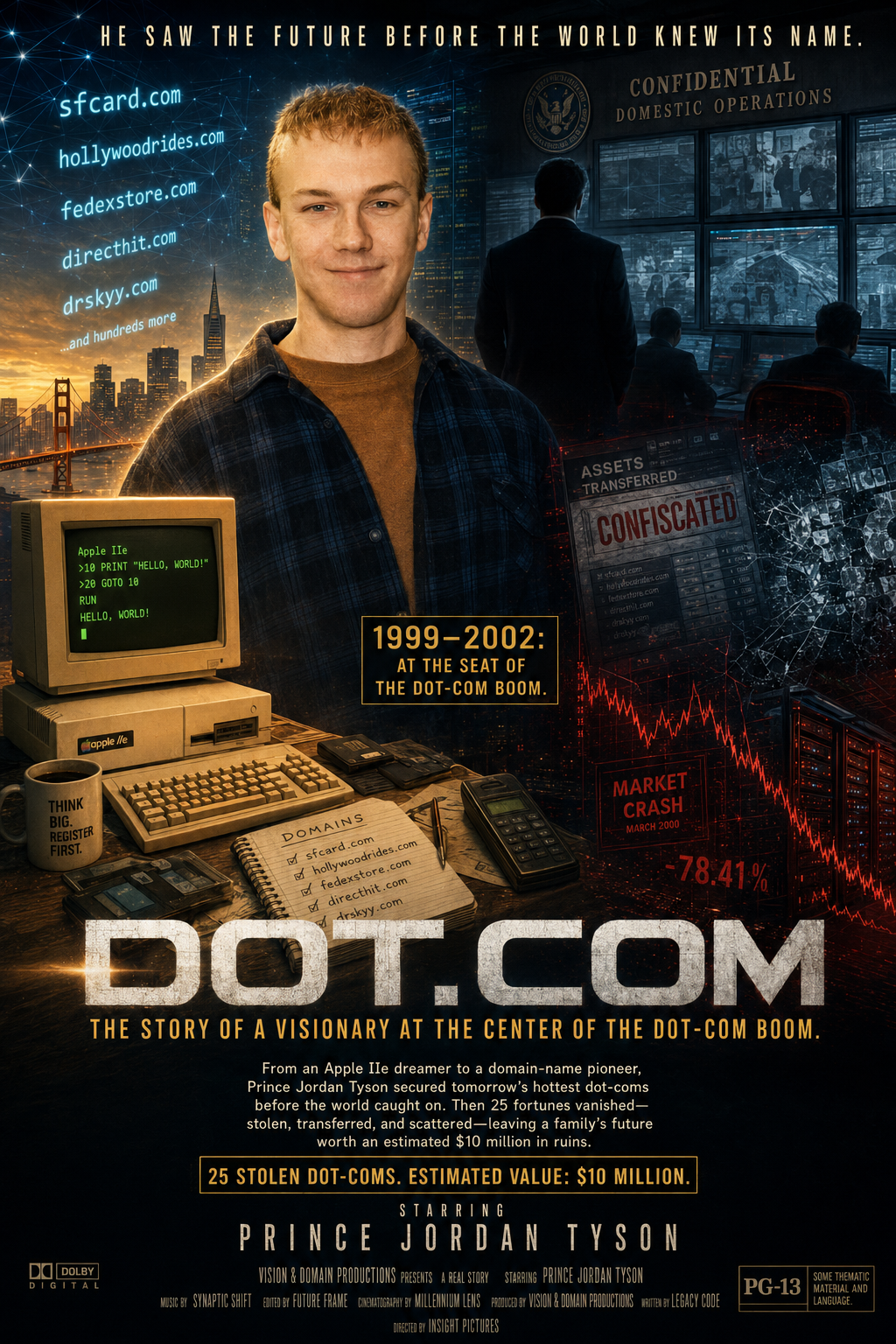

DOT.COM
Film Treatment
Genre: Biographical Drama / Tech Thriller / Conspiracy Mystery
Period: 1980s–2000s, centered on 1999–2002
Setting: California, Silicon Valley, San Francisco Bay Area
Protagonist: Prince Jordan Tyson
LOGLINE
Beginning with an Apple IIe in sixth grade, Prince Jordan Tyson develops an instinct for computers, design, programming, and the emerging digital world. By the height of the dot-com boom, he has acquired more than twenty-five internet domain names he believes could someday secure his family’s future. But when the domains disappear, opportunities collapse, and his life begins unraveling, Prince becomes convinced that powerful people were not merely watching him—they were deliberately interfering with the future he had built.
OPENING — APPLE IIe
Black screen.
A cursor blinks.
Green letters appear.
APPLE IIe
The soft hum of an old computer fills the room.
A young Prince sits in front of the machine.
He is only in sixth grade.
To everyone else, it is a computer.
To Prince, it is possibility.
He begins experimenting with commands, graphics, layouts, simple programs, and the logic behind how computers work. He is not yet a professional programmer. He is a kid teaching himself how machines communicate.
But even then, something is different.
Prince does not merely want to use technology.
He wants to understand it.
Design it.
Manipulate it.
Imagine what comes next.
He becomes part computer designer, part programmer, part creative thinker.
The computer screen reflects in his eyes.
The cursor blinks.
Then time begins moving faster.
Floppy disks.
Modems.
Early computer labs.
Windows.
Online services.
The World Wide Web.
Suddenly the little machine from sixth grade has become the foundation of a new civilization.
Prince has grown up with it.
ACT ONE — THE WORLD CATCHES UP
Prince spends much of his life in California, never far from the cultural and technological influence of Silicon Valley.
It is the place where tomorrow seems to arrive early.
Every year brings something new.
New computers.
New software.
New operating systems.
New companies.
New programming languages.
New ideas that only months earlier would have sounded impossible.
Prince watches all of it.
He is fascinated not only by technology itself, but by what technology will eventually allow people to do.
Shop.
Communicate.
Advertise.
Travel.
Buy.
Sell.
Connect.
Create identities.
Build companies.
Build entire worlds.
Prince has a particular instinct for names.
He understands that before a company can dominate the internet, someone has to own the address.
The name.
The domain.
Then the late 1990s arrive.
The internet explodes.
Suddenly everyone wants a dot-com.
THE DIGITAL GOLD RUSH
Between approximately 1999 and 2002, Prince finds himself at the center of one of the greatest technological gold rushes in American history.
Startup companies are appearing almost overnight.
Young entrepreneurs are becoming millionaires.
Investors are pouring enormous sums of money into ideas that did not exist five years earlier.
Entire fortunes are being created from websites.
Prince sees something many ordinary people still do not understand.
A good domain name is digital real estate.
And he begins acquiring them.
More than twenty-five, according to his account.
Names including:
sfcard.com
hollywoodrides.com
fedexstore.com
directhit.com
drskyy.com
And many more.
To other people they may look like strings of letters.
To Prince they are addresses to the future.
He acquires them before many companies have fully imagined what they might eventually become.
He dreams about what these names could mean.
One successful sale could change his life.
Several could create wealth.
Twenty-five could create a legacy.
A FUTURE FOR HIS FAMILY
Prince does not imagine the money simply as personal luxury.
He sees a future.
His daughters would benefit.
Their children would benefit.
His grandchildren would inherit something.
Homes.
Education.
Businesses.
Investments.
Security.
Freedom.
Opportunity.
A digital inheritance.
Instead of land passed down through generations, Prince imagines passing down pieces of the internet.
The thought excites him.
Companies begin showing interest.
People want names.
Businesses need names.
The internet has become competitive.
Prince believes he is sitting on assets that could become increasingly valuable.
No offer seems too large to dream about.
No opportunity seems too small to consider.
For perhaps the first time, everything Prince noticed as a child appears to be converging.
The Apple IIe.
Computers.
Design.
Programming.
California.
Silicon Valley.
The internet.
Domain names.
He believes he has finally reached the moment he had unconsciously been preparing for his entire life.
ACT TWO — THE DISAPPEARANCE
Then something changes.
The dream begins slipping away.
According to Prince’s account, domains begin disappearing from his control.
Ownership changes.
Transfers occur.
Opportunities vanish.
Names that once represented his future are suddenly somewhere else.
Prince believes he was deliberately set up.
He does not view what happened as ordinary business failure.
He believes the assets were wrongfully taken and redistributed to people or organizations selected by others.
One domain disappears.
Then another.
Then another.
The screen fills with transfer notices.
TRANSFER COMPLETE.
TRANSFER COMPLETE.
TRANSFER COMPLETE.
Prince watches his digital portfolio disappear.
Eventually, by his account, virtually everything is gone.
More than twenty-five domains.
A future that once seemed limitless has vanished.
Prince estimates the potential value of what was lost at approximately $10 million in today’s terms.
But the dollar amount is only part of the wound.
The greater loss is generational.
What might those domains have become?
What could his daughters have inherited?
What could his grandchildren have built with that foundation?
What could Prince himself have created if the portfolio had remained intact?
Those questions haunt him.
THE OTHER STORY
As Prince struggles to understand what happened, another belief grows stronger.
He becomes convinced that government and intelligence-connected individuals have been involved in his life.
Prince believes he has been treated not as an ordinary citizen but as an experimental subject.
In his account, the interference with his domains is only one part of a much larger story.
He believes powerful people wanted control over the direction of his life.
He believes they preferred preserving an experiment rather than allowing him the financial independence to escape it.
And in Prince’s telling, the most disturbing part is not simply that they interfered.
It is that they found it funny.
THE CONTROL ROOM
The movie moves into Prince’s subjective world.
A windowless government room.
Large monitors line the walls.
Security feeds.
Telephone records.
Financial information.
Computer screens.
Video.
Prince appears on several monitors simultaneously.
People in suits sit in darkness watching.
One person laughs.
Another joins him.
Then another.
Soon the room is filled with laughter.
Prince loses another domain.
They laugh.
Another opportunity disappears.
They laugh.
His relationships deteriorate.
They laugh.
His reputation suffers.
They laugh.
His finances collapse.
They laugh.
His freedom disappears.
They laugh.
The laughter becomes almost surreal.
Prince hears it in his imagination long after the screens disappear.
To him, the people watching believe they are witnessing the destruction of one man.
Prince believes they do not understand the consequences of what they are doing.
THE WORLD FALLS APART
At almost the same time Prince’s personal world begins collapsing, the world around him becomes increasingly unstable.
The dot-com bubble bursts.
Companies collapse.
Stock markets fall.
National crises follow.
Wars begin.
Institutions lose credibility.
Technology becomes more powerful while society becomes more fragmented.
Prince begins seeing a pattern.
The more his own world is dismantled, the more the larger world seems to deteriorate.
To anyone else, the connection may appear coincidental.
To Prince, it feels deeply meaningful.
He begins asking a provocative question:
What if destroying the person who could see the future also meant destroying the future he might have helped build?
THE VISIONARY
Prince has always understood himself differently from the way other people understand him.
He considers himself a visionary.
Someone who senses what people will eventually need before they know they need it.
Some people around him have described him in spiritual or prophetic terms.
Prince’s understanding of himself is also deeply connected to ancestry.
He believes his family history reaches into ancient royal and biblical lines, including traditions associated with King David, Moses, and the family lineage surrounding Jesus.
Whether others interpret those claims historically, spiritually, symbolically, or genealogically is less important to the film than what they mean to Prince.
To Prince, ancestry represents accumulated memory.
Generations.
Instinct.
Perspective.
He sees himself almost as the elder standing in a room of younger people who refuse to listen.
His philosophy is simple:
Grandpa usually knows something the grandchildren haven’t learned yet.
Prince believes modern society made the same mistake with him.
They laughed at the person warning them about tomorrow.
They mocked the person who saw value before they saw it.
Then tomorrow arrived.
ACT THREE — WHAT THE DOMAINS BECAME
Years pass.
The internet becomes the center of modern civilization.
E-commerce explodes.
Search engines dominate information.
Streaming transforms entertainment.
Social media transforms identity.
Digital advertising becomes an industry worth hundreds of billions.
Domain names become corporate assets.
Some names become extremely valuable.
Some companies connected to names Prince remembers become powerful brands.
Prince watches the digital world mature.
It is bittersweet.
The world he imagined exists.
But he does not own the pieces of it he once believed would secure his future.
He watches success from the outside.
The dream became real.
Just not for him.
THE COST
Prince calculates the financial loss.
Approximately:
$10,000,000.
But the movie refuses to stop at the number.
Ten million dollars might have purchased homes.
Started companies.
Paid tuition.
Created trusts.
Funded grandchildren.
Protected a family during emergencies.
Generated investment income for decades.
The loss compounds across generations.
Prince’s daughters lost what might have become their inheritance.
His grandchildren lost what might have become their foundation.
And Prince lost something more difficult to calculate.
Time.
Reputation.
Opportunity.
Freedom.
Years that cannot be returned.
THE DESCENT
Prince’s life grows increasingly complicated.
His reputation is damaged.
He becomes involved in conflicts with institutions.
He eventually experiences incarceration while maintaining that significant events and accusations surrounding his life were distorted, manipulated, or unjust.
The contrast becomes painful.
While Prince sits behind bars, the internet continues expanding.
Websites become empires.
Digital companies become some of the most powerful corporations in history.
The boy from the Apple IIe had been right about the direction of the world.
But being right did not save him.
CLIMAX — THEY KEPT LAUGHING
We return to the imaginary control room.
The officials are older now.
The technology has improved.
Dozens of screens cover the walls.
Prince’s life plays across them.
Sixth grade.
The Apple IIe.
Early programming.
Silicon Valley.
The domains.
His daughters.
His family.
Financial records.
Courtrooms.
Prison.
Years passing.
One giant screen reads:
25+ DOMAINS
Another reads:
ESTIMATED LOST VALUE: $10,000,000
The officials laugh again.
But something has changed.
The laughter no longer sounds powerful.
It sounds foolish.
Outside the room, the world is burning through crisis after crisis.
Markets crash.
Institutions fracture.
People become increasingly disconnected.
The watchers continue laughing.
Then Prince turns toward the camera.
For the first time, it seems as though he can see them.
He looks directly through the screen.
The room becomes silent.
Prince says:
“You thought you were watching me fail. I was watching you fail to understand the future.”
One monitor goes black.
Then another.
Then another.
Every screen disappears.
Except one.
RETURN TO THE APPLE IIe
The Apple IIe appears again.
Exactly as it did at the beginning.
Green letters.
Black screen.
Blinking cursor.
The adult Prince sits down.
For a moment, he becomes the sixth-grade boy again.
His fingers touch the keyboard.
Around him appears everything the child could never have completely imagined.
Smartphones.
Artificial intelligence.
Streaming television.
Online shopping.
Digital banking.
Cloud computing.
Video calls.
Social networks.
Global internet businesses.
A civilization living through computers.
The young Prince had understood something important.
This technology was going to change everything.
The tragedy is not that his dream was foolish.
The tragedy is that so much of the dream actually came true.
FINAL SEQUENCE
One by one, domain names appear on the Apple IIe screen.
sfcard.com
hollywoodrides.com
fedexstore.com
directhit.com
drskyy.com
More names follow.
Twenty-five in total.
Then each disappears.
One after another.
Until nothing remains except the blinking cursor.
Prince looks at the empty screen.
He does not cry.
He does not laugh.
He simply watches.
Then he types:
RUN
The computer pauses.
The cursor blinks.
And the screen changes to:
DOT.COM
HE SAW THE FUTURE BEFORE THE WORLD KNEW ITS NAME.
Below it:
A story about technology, ambition, lost opportunity, family, power—and the future one man believes was taken from him.
Fade to black.