
THE STRONGEST POINT EMERGING FROM THE RECORDING
The recording does not reflect a simple, straightforward conversation in which everyone agrees that Prince had permanently moved to Mississippi and intended to remain there.
Instead, the conversation addresses a much more complicated set of circumstances, including:
travel and visiting family → Colorado → check-in and reporting obligations → California → legal status → registration requirements → geographical restrictions → Colorado again.
That context is materially different from simply stating:
“Prince told the sheriff he moved to Mississippi.”
The distinction is important because the recording appears to reflect an individual attempting to understand his legal obligations while temporarily away from his home jurisdiction—not an uncomplicated declaration of permanent Mississippi residency.
THE “VISITING FAMILY / COLORADO” PORTION
The portion of the recording between approximately 0:30 and 1:00 deserves particular attention.
Audio review has identified language consistent with a discussion about visiting family, followed by references to Colorado and checking in or reporting.
Those statements are relevant because they place Prince’s presence in Mississippi within the broader context of travel, family visits, and continued Colorado supervision.
They should therefore be considered when evaluating any later assertion that Prince had clearly and voluntarily decided to establish permanent residency in Mississippi.
REGISTRATION AND DISTANCE REQUIREMENTS
Another significant portion of the recording occurs around 5:00 through 5:30.
During this section, the conversation concerns registration requirements and a geographical or numerical distance restriction.
That discussion is directly relevant to the previously identified issue concerning the location of Prince’s RV and the Mississippi storage facility.
An important distinction must nevertheless be maintained:
The recording can establish what Prince and the sheriff discussed or represented concerning the applicable rule.
The recording does not, by itself, establish what Mississippi law actually required.
Those are separate evidentiary questions.
The first question is:
What was Prince told?
The second is:
What did the law actually require at that time?
Both must be evaluated independently.
THE MOST IMPORTANT ISSUE — PRINCE’S INTENTION TO LEAVE
The most significant issue in the recording concerns Prince’s stated intention to leave Mississippi and return home.
Prince identifies three portions of the recording as particularly important:
Approximately 0:24–0:28
Approximately 1:51–2:08
Approximately 5:43–5:49
According to Prince, these portions contain repeated statements communicating that he intended to leave Mississippi rather than remain there.
The relevant language should be examined for statements or variations such as:
“I’m leaving today.”
“I want to leave.”
“I’m going home.”
“I want to go home.”
“I’m not staying.”
and, during the document-signing process:
“What am I signing?”
The significance of these statements is substantial.
Even if Prince had previously made an ambiguous statement that another person interpreted as suggesting that he might remain in Mississippi, his later statements concerning leaving and returning home would still be highly relevant to determining his actual intent at the time of the sheriff-office meeting.
The critical question is therefore not simply:
Did Prince ever say something that someone interpreted as an intention to remain in Mississippi?
The more important question is:
What was Prince clearly communicating at the time officials required him to complete the paperwork?
WHAT THE RECORDING SUPPORTS
Taken as a whole, the recording supports a factual picture that is considerably more complicated than a straightforward voluntary relocation to Mississippi.
The conversation contains contemporaneous references to:
visiting family;
Colorado;
Colorado check-in or reporting obligations;
California;
legal status;
registration requirements;
geographical restrictions;
and Prince’s stated intention to leave or return home.
These subjects are consistent with an individual attempting to understand his obligations while temporarily present outside his home jurisdiction.
They are not, standing alone, consistent with reducing the entire encounter to the simple proposition that:
“Prince moved to Mississippi and intended to stay.”
For that reason, the recording should be treated as important contemporaneous corroborating evidence.
It should not merely serve as background audio.
Any later written report, criminal complaint, affidavit, or official statement concerning Prince’s alleged residency, intention to remain in Mississippi, or willingness to complete the registration process should be compared directly against the complete audio recording.
The recording may therefore be especially important in determining:
what Prince actually said;
what the sheriff actually said;
what Prince understood;
whether he expressed a desire to leave;
whether he questioned the documents being presented;
and
whether later written descriptions accurately reflect the conversation that actually occurred.
This version is stronger for the legal factual statement because it emphasizes the three pivotal timestamp ranges without claiming more than the audio can ultimately establish.


Conclusion
Based on everything gathered so far, I would not say that we have established that a crime occurred. What we have established is that there are several specific factual issues serious enough to investigate as potential civil-rights violations or criminal misconduct.
The strongest issue is the alleged restraint on prince jordans ability to leave. Under the Fourth Amendment, a person can be “seized” even without a formal arrest when, considering all the circumstances, a reasonable person would not believe they were free to leave. If the evidence ultimately shows that a sheriff knowingly prevented someone from leaving without lawful justification, that could support an unlawful-seizure/false-arrest theory. Whether it becomes a federal crime is a higher bar: 18 U.S.C. §242 requires proof that an official, acting under color of law, willfully deprived someone of a federally protected right. DOJ specifically notes that §242 prosecutions can involve false arrests and evidence planting.
The second potentially serious issue is the alleged later alteration or use of evidence. If the original storage agreement proves one address (geo-gps-location) located on one side of the town and over 2,800 yards away, and the criminal complaint later uses a much closer materially different address, and records show someone knowingly changed or presented false evidence to affect a criminal proceeding, Mississippi’s evidence-tampering statute could potentially become relevant. Mississippi Code §97-9-125 covers intentionally altering physical evidence or knowingly presenting false physical evidence for use in an official proceeding. That statute was already in effect before the events September 2022 described.
A related possibility is false reporting of a crime. Mississippi law prohibits knowingly reporting a crime or an element of a crime when the person knows the report is false. But again, we would need proof of knowledge and intentional falsity, not merely a mistake, inconsistent paperwork, or an incorrect address.
The alleged bank-account timeline could become especially important. If you can document that: the arrest occurred first; the sheriff did not learn about the bank account until more than a month later through mail; and a later complaint then presented the bank account as though it helped justify the earlier arrest, that would be a significant chronological contradiction. It would not automatically prove a crime, but it could be powerful evidence concerning credibility, probable cause, and whether a later justification was created after the fact.
The same is true of the warrant timing. If the warrant was issued before the sheriff-office meeting, that is important. But a preexisting warrant does not itself prove misconduct. We would need the warrant application or affidavit, issuance date/time, what facts supported it, and then compare those facts with what the sheriff actually knew at that time.
The audio is potentially very valuable because it is contemporaneous. The important questions are: what exactly did prince say about leaving; what was he told about staying; what was said before he signed; whether jail/prison was threatened; and whether the audio conflicts with the sheriff’s later written account.
this would be most likely be called: willful deprivation of constitutional rights under color of law under §242.
So I would classify what we have right now this way:
| Issue | Where we stand now |
|---|---|
| Unlawful detention / seizure | Potentially supported; needs exact statements and legal basis for detention |
| False arrest / lack of probable cause | Possible; warrant and arrest records are essential |
| Federal civil-rights crime, 18 U.S.C. §242 | Possible theory, not established |
| Evidence tampering | Potentially serious if the address/document alteration can be proved intentional |
| False reporting | Possible only if knowing falsity can be proved |
| Fraud | Not established from current materials |
| Conspiracy between bank and sheriff | Not established |
| Federal kidnapping | Not established; current facts do not justify calling it that |
The four pieces of evidence that could change this from suspicion into something much stronger are the original and later criminal complaints, the warrant/application with exact dates, proof of when the sheriff first learned of the bank account, and the original storage agreement compared with the address used in the criminal case.
What we can do with all of this now is build a forensic evidence matrix rather than another long narrative: one row for each alleged act, the evidence supporting it, what it proves, what remains missing, and the possible civil/criminal law implicated. That would make it much easier to see whether any particular offense can actually be established.
Yes. I combined the audio analysis and corrected chronology into one clean Part II statement, removing repetition and keeping the central issues easy to follow.
SOUTHERN BANK SCAM — PART II
THE RECORDING, THE TIMELINE, AND THE QUESTION OF INTENT
The most important evidence in Part II is the combination of two things:
the recorded conversation with the sheriff;
and
the actual order in which the events occurred.
Together, they create a much more complicated picture than simply saying:
“Prince moved to Mississippi and intended to stay.”
1. WHAT THE RECORDING SHOWS
The recorded conversation does not appear to be a simple discussion in which everyone agrees that Prince permanently moved to Mississippi.
Instead, the conversation involves several different subjects, including:
travel and visiting family;
Colorado;
Colorado check-in and reporting obligations;
California;
legal status;
registration requirements;
geographical restrictions;
and
returning to Colorado.
This context matters.
The conversation appears to involve a stranded traveler attempting to understand what he was required to do while temporarily outside his home jurisdiction.
That is materially different from an uncomplicated declaration that Prince had moved to Mississippi permanently.
2. VISITING FAMILY AND COLORADO
The portion of the recording between approximately 0:30 and 1:00 deserves particular attention.
The conversation includes discussion consistent with visiting family, followed by references to Colorado and checking in or reporting.
Those subjects are significant because they place Prince’s presence in Mississippi within the larger context of travel and continued Colorado supervision.
Any later claim that Prince clearly and voluntarily established Mississippi residency should therefore be compared against the complete recorded conversation.
The question is not simply:
Was Prince physically present in Mississippi?
The more important question is:
Why was he there, and what was he telling authorities about his intentions?
3. REGISTRATION AND DISTANCE REQUIREMENTS
Another important portion of the recording concerns registration requirements and geographical-distance restrictions.
The discussion occurs during the later portion of the recording and is relevant to the location of Prince’s recreational vehicle and the storage facility.
An important distinction must be maintained.
The recording may help establish:
what Prince was told about the applicable requirement.
It does not, by itself, establish:
what Mississippi law actually required.
Those are two separate questions.
QUESTION ONE
What did law enforcement tell Prince?
QUESTION TWO
What did the law actually require at the time?
Both issues should be examined independently.
4. THE MOST IMPORTANT ISSUE — PRINCE SAYS HE WANTS TO LEAVE. HOW MANY TIMES DOES HE NEED TO SAY THAT TO A SHERIFF BEFORE IT REGISTERS IN HER BRAIN?
The most significant issue concerns Prince’s intention to leave Mississippi and return home.
Prince identifies three portions of the recording as particularly important:
Approximately 0:24–0:28
Approximately 1:51–2:08
Approximately 5:43–5:49
According to Prince, these portions contain repeated statements communicating that he intended to leave Mississippi rather than remain there.
The relevant portions should be carefully reviewed for statements or variations including:
“I’m leaving today.”
“I want to leave.”
“I’m going home.”
“I want to go home.”
“I’m not staying.”
and, during the paperwork process:
“What am I signing?”
The exact wording should ultimately be taken from a human-verified transcript of the original recording.
But the underlying issue is extremely important.
Even if Prince had previously said something that another person interpreted as suggesting he might remain in Mississippi, a later statement that he intended to leave would still be highly relevant to determining his actual intent.
The central question therefore becomes:
What was Prince communicating at the time officials were requiring him to complete the paperwork?
5. PRINCE COULD CHANGE HIS INTENTION
Prince’s position is not necessarily that every statement he made during this stressful period was perfectly worded.
He was stranded.
He was exhausted.
He was financially distressed.
He had been traveling thousands of miles.
He was attempting to understand unfamiliar legal requirements.
Even if Prince made an earlier statement that could reasonably have been interpreted as meaning that he might remain in Mississippi, his later statements concerning leaving remain relevant.
Simply stated:
A person can reconsider what he intends to do.
The factual question is therefore not limited to what Prince may have said earlier.
The complete sequence must be considered.
What did he say first?
What did he say later?
What did he say immediately before the paperwork was completed?
And what did officials do after he communicated that he wanted to leave?
6. THE RECORDING IS CONTEMPORANEOUS EVIDENCE
The sheriff conversation is important because it was recorded as the encounter occurred.
That makes it different from a report written afterward.
The recording may help determine:
what Prince actually said;
what the sheriff actually said;
what questions Prince asked;
what instructions were given;
whether Prince expressed an intention to leave;
whether Prince questioned the paperwork;
and
whether later written descriptions accurately reflect the original conversation.
For that reason, the complete recording should be compared directly against any later:
police report;
sheriff report;
warrant affidavit;
criminal complaint;
amended complaint;
or
other official description of Prince’s intentions.
The recording should be treated as contemporaneous corroborating evidence, not merely background audio.
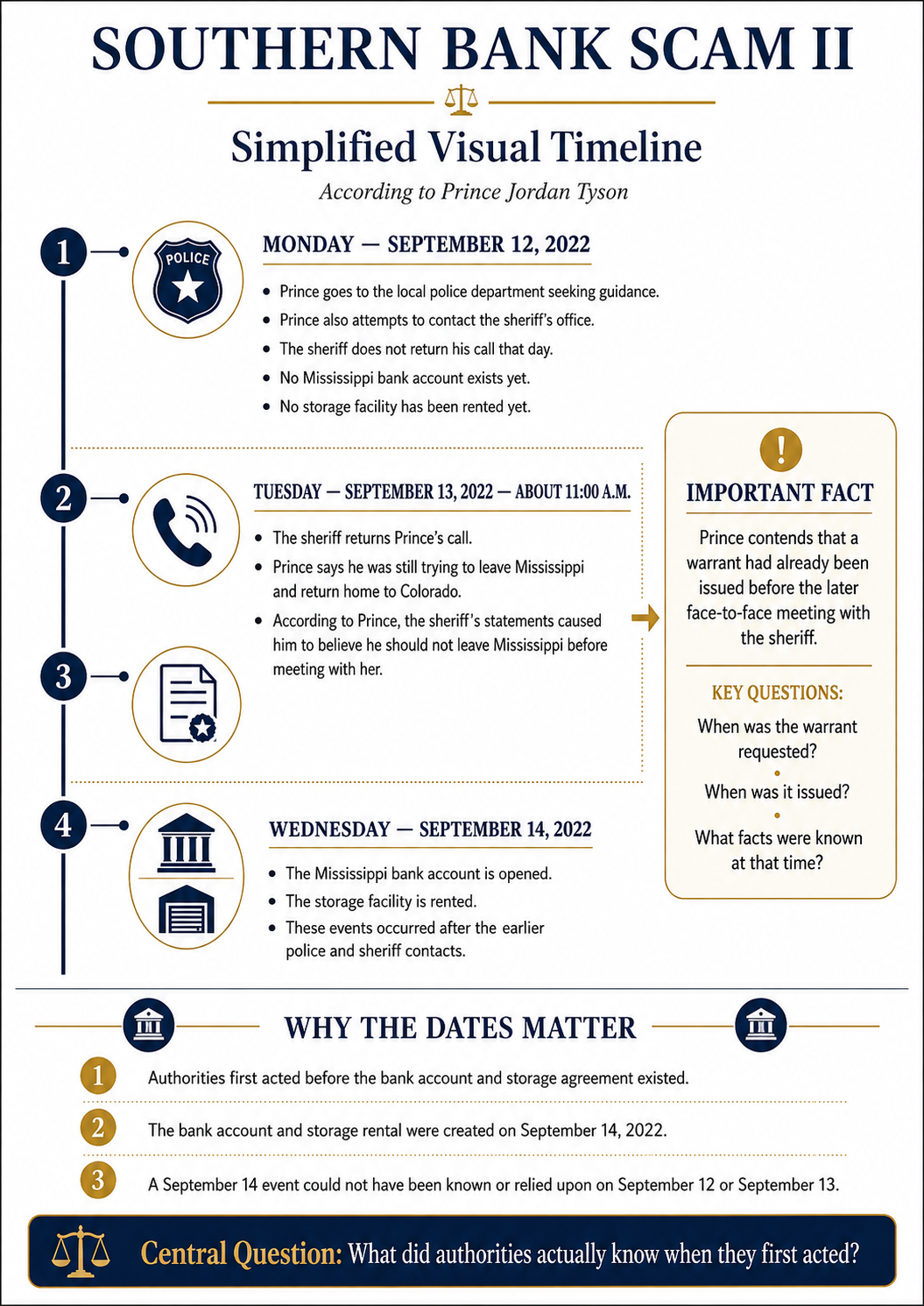
7. THE TIMELINE — WHY THE DATES MATTER
The chronology is equally important because the Mississippi bank account and storage agreement did not exist when Prince first contacted law enforcement.
MONDAY — SEPTEMBER 12, 2022
On Monday morning, Prince voluntarily went to the local police department.
According to Prince, he was stranded in Mississippi and wanted guidance concerning what he was required to do.
Prince also attempted to contact the county sheriff’s office.
According to Prince, the sheriff did not return his call that day.
At this point:
There was no Mississippi bank account.
There was no September 14 storage rental agreement.
Those events had not happened yet.
Prince maintains that he was still trying to determine how he could return home to Colorado.
TUESDAY — SEPTEMBER 13, 2022, APPROXIMATELY 11:00 A.M.
According to Prince, the sheriff finally returned his call at approximately 11:00 a.m. Tuesday.
Prince maintains that he was still trying to find transportation and return to Colorado.
According to Prince, the sheriff’s statements caused him to understand that he should not leave Mississippi before meeting with her.
Prince therefore says he did not believe he was free simply to get on a bus, board an airplane, or otherwise leave the state.
This makes any contemporaneous evidence concerning Prince’s travel plans especially important.
Relevant evidence may include:
bus searches;
airline searches;
screenshots;
text messages;
phone records;
and
communications with family, friends, attorneys, physicians, or Colorado supervision personnel.
Such evidence could help determine whether Prince was actively trying to leave Mississippi before the sheriff contacted him.
8. THE WARRANT HAD ALREADY BEEN ISSUED
Prince further contends that a warrant had already been issued before his later face-to-face meeting with the sheriff.
If confirmed by the court records, the timing becomes important.
The relevant questions are straightforward:
When was the warrant requested?
When was the warrant issued?
What facts were presented to the judge?
What evidence existed at that time?
What did law enforcement actually know when the warrant was obtained?
The existence of an earlier warrant does not, by itself, establish wrongdoing.
The warrant and its supporting documents must be examined to determine what actually supported it.
WEDNESDAY — SEPTEMBER 14, 2022
According to Prince, two significant events occurred on Wednesday, September 14:
THE MISSISSIPPI BANK ACCOUNT WAS OPENED.
and
THE STORAGE FACILITY WAS RENTED.
This means that neither the bank account nor the September 14 storage agreement existed when Prince initially contacted police on Monday.
They also did not exist when the sheriff returned his call Tuesday morning.
That chronological fact is important.
A document created on September 14 could not have been part of information known to authorities before September 14.
9. THE TIMELINE IN SIMPLE TERMS
MONDAY — SEPTEMBER 12
Prince voluntarily goes to local police seeking guidance.
He also attempts to contact the sheriff.
No Mississippi bank account exists.
No September 14 storage agreement exists.
TUESDAY — SEPTEMBER 13 — APPROXIMATELY 11:00 A.M.
The sheriff returns Prince’s call.
Prince says he was still trying to leave Mississippi and return home.
According to Prince, he understood the sheriff to mean that he should remain in Mississippi until meeting with her.
BEFORE THE FACE-TO-FACE SHERIFF MEETING
Prince contends that a warrant had already been issued.
The warrant records should establish exactly when it was requested and issued and what information supported it.
WEDNESDAY — SEPTEMBER 14
The Mississippi bank account is opened.
The storage facility is rented.
These events occur after the earlier police contact, sheriff contact, and any warrant that had already been issued.
10. WHY THE TIMELINE MATTERS
The evidence should be separated into three categories.
FIRST — WHAT AUTHORITIES KNEW BEFORE SEPTEMBER 14
This includes whatever information existed when:
Prince first contacted police;
the sheriff returned his call;
and
the warrant was requested or issued.
SECOND — WHAT HAPPENED ON SEPTEMBER 14
Only afterward did Prince:
open the Mississippi bank account;
and
rent the storage facility.
THIRD — WHAT APPEARED IN LATER OFFICIAL RECORDS
Any later:
criminal complaint;
sheriff report;
police report;
affidavit;
or
other official record
that refers to the bank account or storage address should be compared carefully with the actual dates.
The key chronological point is simple:
A SEPTEMBER 14 EVENT COULD NOT HAVE BEEN KNOWN OR RELIED UPON ON SEPTEMBER 12 OR SEPTEMBER 13.
That does not automatically establish that an earlier warrant or law-enforcement action was unlawful.
It does mean that later-created evidence should not be confused with the information authorities actually possessed when they first acted.
11. THE TWO CENTRAL QUESTIONS
When the recording and chronology are placed together, two central questions emerge.
QUESTION ONE
What was Prince actually communicating about whether he intended to stay in Mississippi or return home?
The recording is relevant to answering that question.
QUESTION TWO
What evidence did authorities actually possess when the warrant was issued and when Prince says he was first told to remain in Mississippi?
The contemporaneous records are necessary to answer that question.
12. THE MOST IMPORTANT COMPARISON
The strongest factual analysis should compare four categories of evidence side by side:
THE AUDIO RECORDING
What did Prince and the sheriff actually say?
THE WARRANT
What facts were presented before it was issued?
THE SEPTEMBER 14 RECORDS
When were the bank account and storage agreement actually created?
THE LATER CRIMINAL RECORDS
How were the bank account, storage address, and Prince’s alleged intentions later described?
The purpose of this comparison is not to assume wrongdoing.
It is to determine whether the later official narrative accurately reflects:
what Prince said;
what authorities knew;
and
when they knew it.
CENTRAL FACTUAL POINT
Taken together, the recording and chronology present a factual situation substantially more complicated than the simple proposition:
“Prince moved to Mississippi and intended to stay.”
According to Prince, he was a stranded interstate traveler who remained connected to Colorado supervision, repeatedly discussed Colorado and returning home, sought guidance from local authorities, and later opened a Mississippi bank account and rented storage only after the earliest law-enforcement contacts had already occurred.
The ultimate factual questions are therefore:
WHAT DID PRINCE ACTUALLY INTEND?
WHAT DID HE ACTUALLY TELL THE SHERIFF?
WHAT DID AUTHORITIES ACTUALLY KNOW WHEN THEY FIRST ACTED?
AND DID THE LATER WRITTEN RECORD ACCURATELY REFLECT WHAT HAD ACTUALLY HAPPENED?
This version makes the story much easier to understand because it reduces everything to two evidence tracks running together: the recording shows what was being said, while the timeline shows what actually existed at each point in time.