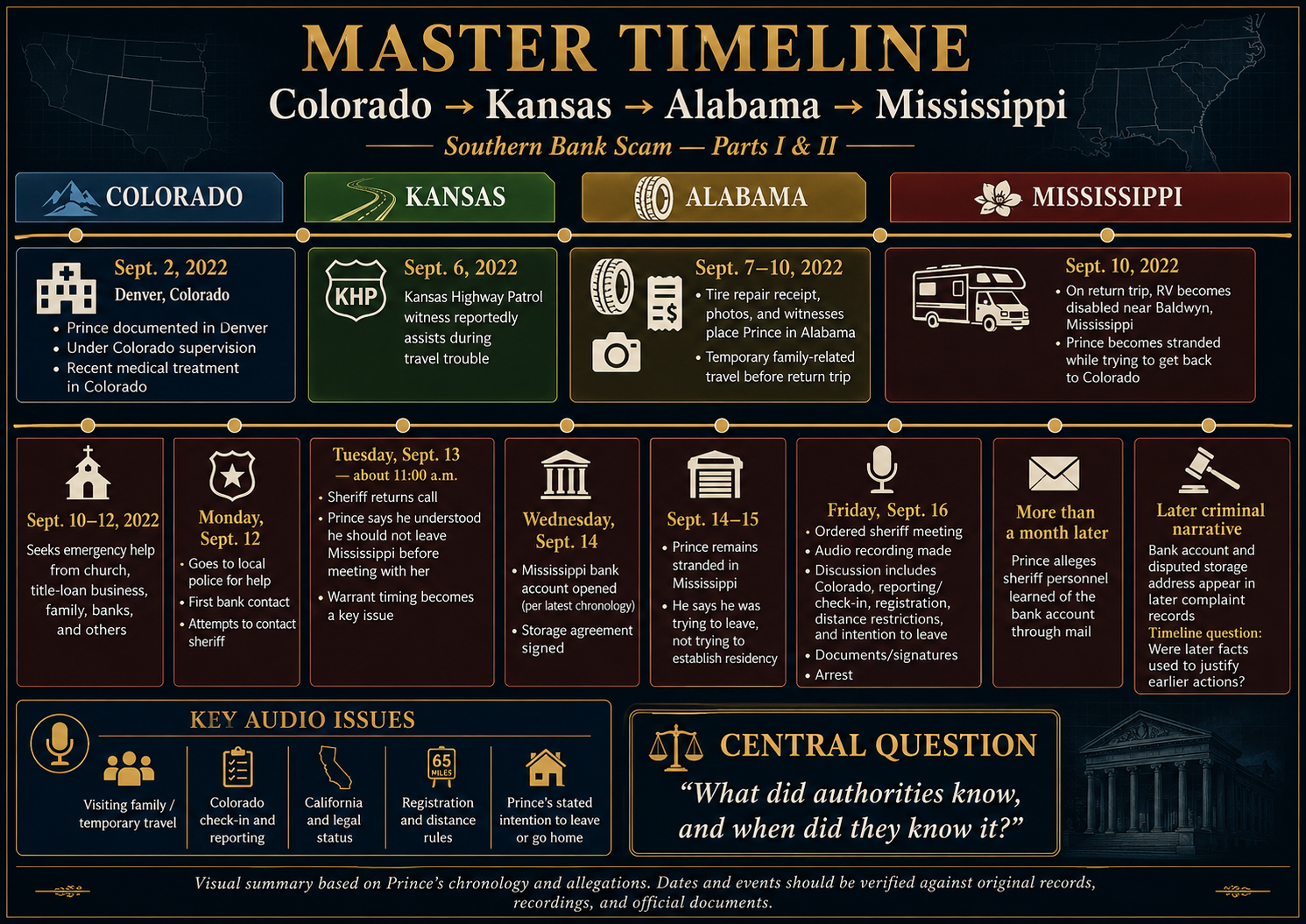
MASTER CHRONOLOGICAL TIMELINE
COLORADO → KANSAS → ALABAMA → MISSISSIPPI
SOUTHERN BANK SCAM — PARTS I & II
Purpose: To place the travel, medical circumstances, banking events, law-enforcement contacts, sheriff communications, warrant, storage agreement, arrest, and later disputed records into one understandable chronological sequence.
Important: This timeline distinguishes between documented dates, Prince’s account of events, and matters that still require confirmation from the original records.
SEPTEMBER 2, 2022
DENVER, COLORADO
Prince is physically present in Denver, Colorado.
According to prior records identified by Prince, an Assistant Colorado Attorney General was with or had direct contact with him in Denver on September 2.
Prince remained under Colorado supervision and jurisdiction.
Prior materials state that Prince had authorization or an understood period in which to travel to Alabama and return to Colorado.
This date is important because later Mississippi allegations reportedly describe Prince as residing in Mississippi during a period beginning as early as September 2, 2022.
However, Prince contends that evidence places him in Colorado on September 2.
EVIDENCE IDENTIFIED
Colorado records
Assistant Attorney General witness/contact
Supervision records
Telephone records
Travel records
Prior materials specifically identify September 2 as a Colorado date.
EARLY SEPTEMBER 2022
COLORADO MEDICAL TREATMENT
Before continuing the trip, Prince reports receiving emergency medical treatment in Colorado.
He states that he was suffering from serious exhaustion and other medical problems while traveling.
The existing legal statement describes recent emergency-room treatment in Colorado and significant physical symptoms during the trip.
This becomes important later because Prince maintains that many of the statements and decisions he made during the trip occurred while he was:
physically exhausted;
medically vulnerable;
under stress;
and
trying to get back home.
SEPTEMBER 3–5, 2022
TRAVEL EAST FROM COLORADO
Prince begins traveling east from Colorado toward Alabama.
The exact locations and overnight stops for these dates should be filled in from:
cellphone location information;
fuel receipts;
photographs;
toll records;
credit-card statements;
GPS information;
witness statements.
These dates should not be guessed if the records can establish them.
SEPTEMBER 6, 2022
KANSAS
Prince is in Kansas.
According to his prior materials, he encounters another travel emergency or vehicle problem.
A Kansas Highway Patrol witness allegedly assists him while he is stranded.
This date is significant because it provides another location outside Mississippi during the period that Prince says was later characterized as Mississippi residency.
EVIDENCE IDENTIFIED
Kansas Highway Patrol witness
Vehicle/travel records
Phone-location information
Receipts or photographs
Prior materials specifically identify September 6, 2022 — Kansas.
SEPTEMBER 7–10, 2022
ALABAMA
Prince reaches Alabama.
According to prior materials, evidence placing him in Alabama includes:
tire-repair records;
photographs containing metadata;
witnesses;
travel records.
The previously prepared material identifies Prince as being in Alabama from approximately September 7 through September 10, 2022.
Prince maintains that the Alabama trip involved visiting family and was temporary.
He did not consider Mississippi his destination or intended residence.
His plan remained to return to Colorado.
SEPTEMBER 10, 2022
LEAVING ALABAMA / ENTERING MISSISSIPPI AREA
After Alabama, Prince begins the return trip toward Colorado.
During this return trip, Prince enters northeastern Mississippi.
His recreational vehicle develops serious problems, leaving him stranded in or around Baldwyn, Mississippi.
Prior records describe the RV as being parked at or near a truck stop along Highway 45 beginning around September 10.
This is the central transition:
PRINCE DID NOT TRAVEL TO MISSISSIPPI AS HIS FINAL DESTINATION.
According to his account, Mississippi became relevant because:
the RV became disabled while he was trying to return home.
SEPTEMBER 10–12, 2022
STRANDED IN MISSISSIPPI
Prince remains in the Baldwyn area because of the RV problem.
He has limited money and is approximately 2,000 miles from his Colorado home and family.
The existing factual statement describes him as stranded with very little money after thousands of miles of travel.
During this period, Prince seeks emergency assistance from multiple sources.
According to the existing records, those efforts include:
family members;
friends;
attorneys;
physicians;
existing banking relationships;
a local church;
a title-loan business;
a Mississippi bank.
The earlier legal statement also identifies recordings made at a church and title-loan business as evidence that Prince was asking for assistance to return home.
MONDAY — SEPTEMBER 12, 2022
PRINCE GOES TO POLICE FOR HELP
On Monday morning, Prince voluntarily goes to local police seeking guidance.
According to Prince, he explains that:
he is stranded;
his RV has problems;
he is trying to return to Colorado;
he needs somewhere safe to keep the RV;
and he does not want to accidentally violate any rules while temporarily in Mississippi.
Prior materials specifically identify September 12, 2022 as the date Prince sought help from Baldwyn police and other local authorities.
This contact is voluntary.
Prince says he goes to police because he expects them to help him understand what he should do.
SEPTEMBER 12, 2022
FIRST BANK CONTACT
Prior materials state that Prince also first went to the Mississippi bank on Monday, September 12.
This appears to have been an initial bank contact, not necessarily the final opening of the account.
Prince seeks an emergency loan because he needs money to repair the RV or otherwise return to Colorado.
His position is that:
he went to the bank looking for a way home—not looking for a new home.
SEPTEMBER 12, 2022
POLICE DISCUSSION OF TEMPORARY PARKING
Prince discusses where the RV can safely remain.
According to Prince, a local officer discusses a geographical restriction and provides a figure of approximately 1,500 feet.
Prince identifies a location he believes is approximately 2,800 feet from the relevant school or restricted location.
According to Prince, he believes the proposed location is acceptable based upon what the officer tells him.
This later becomes important because Prince alleges that a different address—approximately 1,000 feet from the school—eventually appears in the criminal record.
The later treatment specifically identifies this alleged 2,800-foot versus 1,000-foot discrepancy.
MONDAY — SEPTEMBER 12, 2022
PRINCE ATTEMPTS TO CONTACT THE SHERIFF
After speaking with local police, Prince attempts to contact the sheriff’s office.
According to Prince:
the sheriff does not return his call on Monday.
Prince remains stranded.
He continues looking for ways to return to Colorado.
MONDAY NIGHT — SEPTEMBER 12, 2022
Prince remains in or around his RV.
According to his materials, the RV is still at or near the Highway 45 truck-stop area.
He continues contacting people and trying to solve the transportation problem.
TUESDAY — SEPTEMBER 13, 2022
APPROXIMATELY 11:00 A.M. — SHERIFF RETURNS THE CALL
According to Prince’s corrected chronology, the sheriff finally returns his call at approximately 11:00 a.m. Tuesday morning.
At this point, according to Prince:
he still wants to leave Mississippi;
he is still trying to return to Colorado;
and
he has not voluntarily decided to make Mississippi his permanent home.
SEPTEMBER 13, 2022
THE ALLEGED “DO NOT LEAVE” INSTRUCTION
According to Prince, the sheriff tells or directs him to remain in Mississippi until she can meet with him.
Prince understands the communication to mean:
he is not free to cross state lines and return to Colorado before the meeting.
Whether this legally constituted a detention is a legal question.
Prince’s factual position is that he believed law enforcement had ordered him not to leave.
Prior materials place the beginning of this alleged restriction on or about September 13 and describe Prince remaining at the truck-stop area through September 16.
SEPTEMBER 13, 2022
TRANSPORTATION HOME BECOMES IMPORTANT EVIDENCE
Prince says he had been examining ways to leave Mississippi.
Potential evidence includes:
airline searches;
bus searches;
screenshots;
telephone records;
messages to family;
messages to attorneys;
communications with Colorado supervision.
These records could help answer a basic factual question:
WAS PRINCE TRYING TO LEAVE MISSISSIPPI?
If so, that evidence would be relevant when evaluating whether his continued physical presence represented voluntary residency.
SEPTEMBER 13, 2022
WARRANT ISSUE — EXACT TIME MUST BE VERIFIED
Prince contends that a warrant had already been issued before his later face-to-face meeting with the sheriff.
The precise warrant chronology should come directly from:
the warrant;
the warrant application;
the supporting affidavit;
judge/court records;
filing timestamps.
The essential questions are:
When was the warrant requested?
When was it signed?
What information supported it?
What did authorities actually know at that moment?
Prior materials allege a warrant was issued at approximately this point in the sequence, before the later ordered meeting.
WEDNESDAY — SEPTEMBER 14, 2022
BANK ACCOUNT
Using Prince’s latest corrected chronology, the Mississippi bank account is opened on September 14, 2022.
This date should ultimately be confirmed using the bank’s:
account-opening record;
signature card;
computer timestamp;
customer profile;
transaction history.
IMPORTANT CHRONOLOGICAL POINT
If the bank account was opened on September 14:
it did not exist when Prince went to police on September 12.
It did not exist when the sheriff called him on September 13.
And if the warrant had already been issued:
the bank account could not have been part of the information supporting that earlier warrant.
WEDNESDAY — SEPTEMBER 14, 2022
STORAGE AGREEMENT
According to Prince’s latest chronology, the storage facility is formally rented or the storage agreement is signed on September 14, 2022.
This date is especially important.
If the storage agreement did not exist until September 14, it likewise could not have been relied upon before September 14.
The original storage agreement should establish:
exact facility;
exact address;
date signed;
unit information;
payment information.
SEPTEMBER 14–15, 2022
PRINCE REMAINS IN MISSISSIPPI
Prince remains in Mississippi.
His position is that this continued presence was not voluntary evidence of residency.
According to Prince, he remained because:
his RV was disabled;
he had little money;
he was trying to solve the transportation problem;
and, after the sheriff’s Tuesday communication, he believed he had been instructed not to leave before meeting with her.
This distinction becomes central:
PHYSICAL PRESENCE IS NOT NECESSARILY THE SAME THING AS INTENT TO RESIDE.
FRIDAY — SEPTEMBER 16, 2022
ORDERED SHERIFF MEETING
Prior records identify September 16, 2022 as the date of the ordered face-to-face meeting with the sheriff.
Prince appears at the sheriff’s office.
According to Prince, he attends because he believes he has been ordered to do so.
SEPTEMBER 16, 2022
PRINCE RECORDS THE SHERIFF MEETING
Prince audio-records the encounter.
The recording becomes critically important because it provides contemporaneous evidence of the conversation.
The recording contains discussion involving:
travel;
family;
Colorado;
check-in/reporting obligations;
California;
registration;
geographical restrictions;
Prince’s intentions.
Prince identifies several portions of the recording as containing statements that he intended to leave Mississippi or return home.
Those timestamp ranges include:
approximately 0:24–0:28;
approximately 1:51–2:08;
and
approximately 5:43–5:49.
The exact wording should be established through a human-verified transcript before being quoted in legal materials.
SEPTEMBER 16, 2022
“I WANT TO LEAVE”
Prince’s position is that he makes his present intention clear during the sheriff encounter:
he wants to leave Mississippi and return home.
Even if some earlier statement had been interpreted differently, Prince maintains that his statements at the meeting were relevant to his actual intention at that time.
The central issue becomes:
WHAT WAS PRINCE SAYING BEFORE HE SIGNED THE PAPERWORK?
SEPTEMBER 16, 2022
DOCUMENTS AND SIGNATURES
According to Prince, documents are presented for signature.
He maintains that he questions what he is being asked to sign and does not fully understand why the documents are required.
Prince contends that he was:
exhausted;
medically compromised;
frightened;
under significant pressure;
and did not believe he was free simply to walk away.
The audio recording is important because it can be compared with later descriptions of the encounter.
SEPTEMBER 16, 2022
ARREST
According to Prince, after the signing process he is arrested.
Prior materials specifically identify the September 16 ordered meeting as the point at which Lee County authorities arrested him.
The exact:
charge;
statutory basis;
warrant;
arrest time;
probable-cause statement;
and complaint
should be taken directly from the official records.
THE ALLEGED RESIDENCY PERIOD
Prince states that later criminal materials treated him as though he had resided in Mississippi for a period extending approximately:
SEPTEMBER 2 THROUGH SEPTEMBER 16, 2022
That alleged period creates a major chronological issue because Prince identifies evidence placing him elsewhere during significant portions of that same period:
SEPTEMBER 2 — COLORADO
SEPTEMBER 6 — KANSAS
SEPTEMBER 7–10 — ALABAMA
Only afterward does the chronology place him in Mississippi.
The earlier website material specifically identifies this conflict.
AFTER THE ARREST
JAIL AND MAIL
While incarcerated, Prince sends and receives correspondence.
According to Prince, bank-related mail eventually comes to the attention of sheriff personnel.
This becomes important because Prince alleges that the sheriff did not originally know about the Mississippi bank account when the earlier decisions were made.
MORE THAN ONE MONTH AFTER THE ARREST
ALLEGED DISCOVERY OF THE BANK ACCOUNT
According to Prince, sheriff personnel discover the existence of the local bank account through his mail more than a month after the arrest.
That allegation appears throughout the later treatment materials.
If records confirm that timing, it creates an important question:
HOW COULD THE BANK ACCOUNT HAVE JUSTIFIED AN EARLIER DECISION IF AUTHORITIES DID NOT YET KNOW IT EXISTED?
LATER
THE CRIMINAL COMPLAINT
According to Prince, later versions of the criminal narrative refer to:
the Mississippi bank account;
and
the storage address
as evidence of a Mississippi connection or residency.
Prince disputes that chronology.
He alleges that information learned later was presented in a manner suggesting it had supported earlier decisions.
This should be tested by comparing:
original complaint;
amended complaint;
warrant affidavit;
arrest report;
bank records;
date sheriff learned about the account.
The later treatment identifies this precise chronology dispute.
LATER
THE DISPUTED STORAGE ADDRESS
Prince alleges another important discrepancy.
According to Prince:
the actual storage location he rented was approximately 2,800 feet from the relevant school or restricted location.
But:
a different address later appearing in the criminal complaint was approximately 1,000 feet away.
Prince contends that these were different locations.
The source materials explicitly identify this alleged address discrepancy.
This requires comparison of:
original storage contract;
address used in warrant;
address used in complaint;
maps;
property records;
professionally verified distance measurements.
MASTER TIMELINE — ONE-PAGE VERSION
SEPTEMBER 2 — COLORADO
Prince documented in Denver; Colorado supervision remains relevant.
↓
SEPTEMBER 6 — KANSAS
Kansas Highway Patrol allegedly assists Prince during travel trouble.
↓
SEPTEMBER 7–10 — ALABAMA
Prince visits Alabama; tire receipt, photographs, metadata, and witnesses allegedly document his presence.
↓
SEPTEMBER 10 — MISSISSIPPI
Prince enters Mississippi while returning toward Colorado; RV problems leave him stranded.
↓
SEPTEMBER 10–12
Prince seeks emergency financial and practical assistance.
↓
MONDAY, SEPTEMBER 12
Prince voluntarily goes to police for help.
Prince attempts to contact sheriff.
Prince has initial bank contact.
No final September 14 bank/storage documents yet.
↓
TUESDAY, SEPTEMBER 13 — ABOUT 11 A.M.
Sheriff returns Prince’s call.
Prince says he is trying to return home.
Prince alleges he understands sheriff to mean he should not leave before meeting with her.
↓
SEPTEMBER 13
Prince contends a warrant is already issued before the later face-to-face sheriff meeting.
↓
WEDNESDAY, SEPTEMBER 14
Mississippi bank account opened — latest corrected date supplied by Prince.
↓
WEDNESDAY, SEPTEMBER 14
Storage agreement signed/rented.
↓
SEPTEMBER 14–15
Prince remains in Mississippi while stranded and, according to him, under instruction not to leave.
↓
FRIDAY, SEPTEMBER 16
Ordered sheriff meeting.
Prince audio-records encounter.
Prince says he wants to leave/return home.
Documents presented and signed.
Prince arrested.
↓
AFTER ARREST
Prince incarcerated.
Bank mail eventually comes to sheriff personnel’s attention.
↓
MORE THAN A MONTH LATER — ACCORDING TO PRINCE
Sheriff allegedly first learns of the bank account through mail.
↓
LATER CRIMINAL RECORDS
Bank account and storage address allegedly appear in later criminal narrative.
↓
LATER ADDRESS DISPUTE
Prince alleges criminal paperwork uses a different storage address from the location actually rented.
THE CENTRAL CHRONOLOGICAL QUESTION
When the entire journey is viewed from beginning to end, the key question becomes much simpler:
WHEN DID PRINCE ACTUALLY ARRIVE IN MISSISSIPPI, WHY WAS HE THERE, WHAT DID HE SAY HE INTENDED TO DO, AND WHAT DID AUTHORITIES ACTUALLY KNOW AT EACH POINT IN TIME?
The chronology should not collapse all of these events into a single statement that Prince simply “moved to Mississippi.”
According to the evidence identified by Prince, the sequence instead begins with:
Colorado → interstate travel → Kansas → Alabama → return trip → Mississippi breakdown → temporary emergency → requests for help → police contact → sheriff contact → bank/storage paperwork → sheriff meeting → arrest → later-discovered records.
That sequence is the factual backbone of both Southern Bank Scam Part I and Part II.
IMPORTANT DATE TO VERIFY
One older website draft states that the bank account was opened on September 13 at approximately 8:30 a.m.
Prince has now corrected that date and states that the account was opened on September 14, 2022.
Because the distinction could be legally important, the final public/legal timeline should use the actual bank-generated account-opening timestamp once obtained rather than either draft version.
The storage agreement is consistently identified in the existing materials as being formally signed on September 14, 2022.
This single verification should be completed before treating the master timeline as final.
This gives you a true start-to-finish master timeline, rather than beginning the story only when Prince reaches Mississippi. The strongest visual structure for the website would be four geographic chapters: COLORADO → KANSAS → ALABAMA → MISSISSIPPI, with the Mississippi portion expanding day-by-day from September 10 through September 16.