
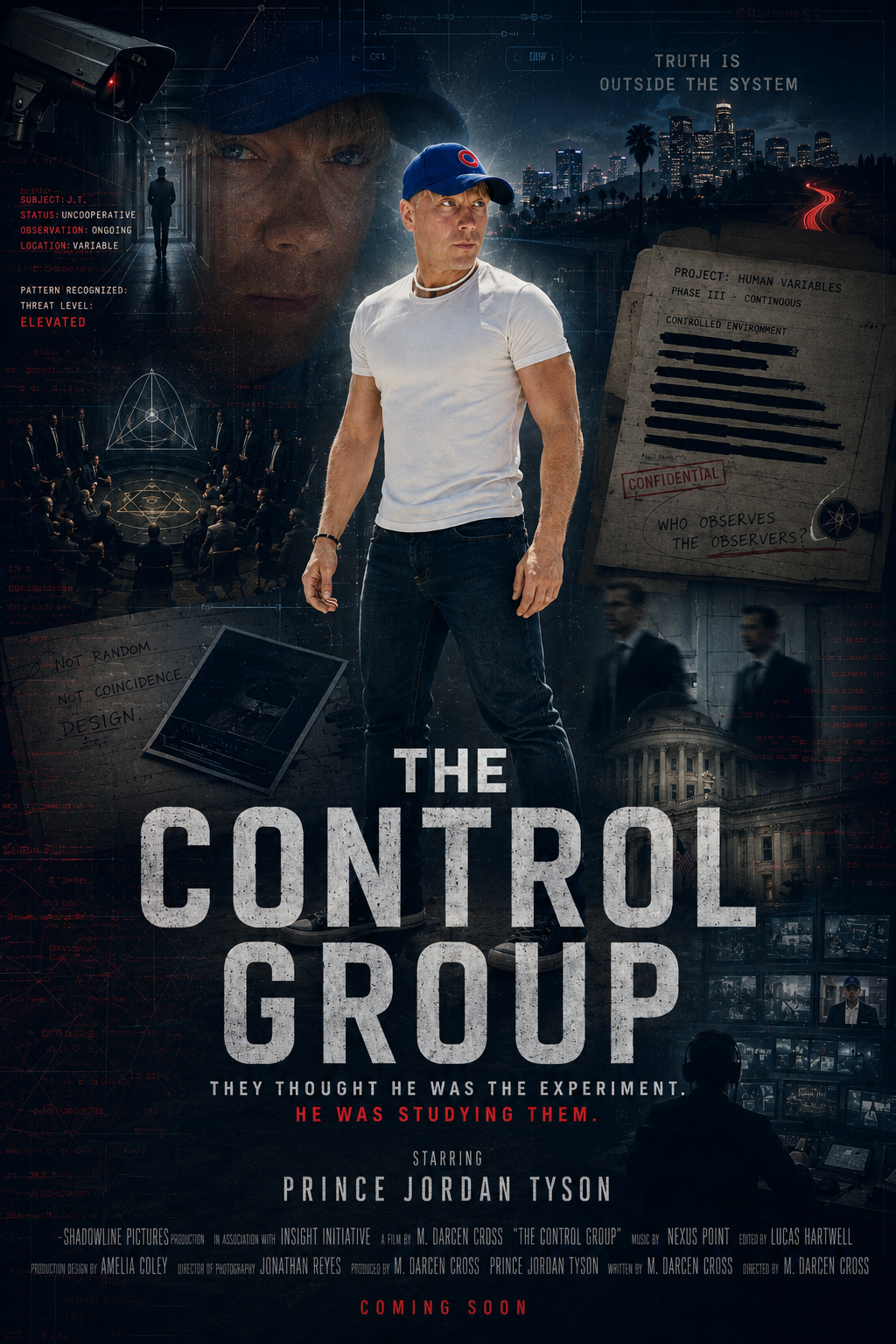
Absolutely. The strongest version is a psychological conspiracy thriller in which Prince’s allegations and experiences drive the story, while the audience discovers the pattern with him. That keeps the movie intense without requiring the treatment to declare disputed accusations about real organizations as established fact.
THE CONTROL GROUP
Genre: Psychological Conspiracy Thriller / Investigative Drama / Techno-Thriller
Format: Feature Film
Setting: California and the American South, 1995–Present
Protagonist: Prince Jordan Tyson
Tagline: They thought he was the experiment. He was studying them.
LOGLINE
For nearly three decades, an unusually perceptive man who instinctively recognizes patterns in people, computers, behavior, and systems becomes convinced that the world surrounding him has been deliberately manipulated. As he attempts to escape what he believes is a covert network operating behind respected organizations, every effort to expose it appears to tighten the trap around him—until he realizes that surviving may depend upon doing the one thing his adversaries never anticipated: studying the people who believed they were studying him.
THE PREMISE
To the outside world, the organizations Prince encounters appear legitimate.
They hold meetings. They have buildings, ceremonies, memberships, rules, titles and hierarchies. They resemble private clubs whose members seem extraordinarily concerned with belonging, loyalty and obedience.
Prince sees something different.
To him, there is an almost childish quality beneath the formality—a grown-up version of a clubhouse, treehouse or neighborhood fort where insiders make the rules and anyone refusing to cooperate is pushed outside the circle.
But Prince gradually comes to believe that the clubhouse is merely the outermost layer.
Behind it, he suspects something much larger.
Secret relationships.
Government connections.
Surveillance.
Psychological operations.
People appearing in his life who do not seem to behave naturally.
Situations that repeat themselves too perfectly.
People who arrive at exactly the right moment.
Institutions that appear independent but somehow behave as though they are communicating with one another.
Prince begins referring to it simply as:
The Control Group.
PRINCE
Prince Jordan Tyson has always noticed patterns.
Since childhood, computers make sense to him.
Algorithms make sense.
Systems make sense.
People make sense.
He does not necessarily know how he knows something is wrong. He simply recognizes when the pattern does not fit.
A computer program can imitate intelligence.
A machine can reproduce music.
An actor can imitate emotion.
But imitation always leaves something behind.
A rhythm.
A delay.
A repetition.
A mistake.
To everyone else, it may sound real.
To Prince, it sounds counterfeit.
And Prince eventually begins noticing the same phenomenon in people.
Certain conversations seem scripted.
Certain strangers seem unusually interested in him.
Different people use remarkably similar phrases.
People who supposedly do not know each other appear to possess the same information.
Coincidences begin repeating themselves until Prince no longer considers them coincidences.
His greatest strength becomes his greatest problem:
Prince notices.
ACT ONE — THE CLUBHOUSE
California, 1995
Prince is young, ambitious and fascinated by technology.
California is exploding with innovation.
Silicon Valley is transforming the world.
Computers are becoming faster.
The Internet is becoming public.
Information is becoming power.
Prince believes the future will belong to people capable of understanding systems.
At the same time, he begins encountering individuals connected to organizations including Freemasonry, Scientology and other private networks.
At first, Prince finds the culture almost comical.
Secret handshakes.
Ranks.
Private meetings.
Membership rules.
People obsessed with who belongs and who does not.
To Prince, these supposedly sophisticated organizations sometimes resemble children who never outgrew their neighborhood clubhouse.
But the humor gradually disappears.
Prince begins believing some people around these organizations possess connections extending far beyond ordinary membership.
Police.
Government workers.
Businessmen.
Attorneys.
Medical professionals.
Political figures.
Security personnel.
Federal employees.
People from entirely different parts of his life seem strangely interconnected.
Prince attempts to distance himself.
The network appears to follow.
THE PATTERN
Over the following years, Prince begins documenting incidents.
Names.
Dates.
Addresses.
License plates.
Telephone numbers.
Court records.
Photographs.
Repeated phrases.
Unexpected encounters.
Relationships between individuals.
He creates diagrams resembling computer networks.
One person connects to another.
One organization connects to another.
A friend connects to an employer.
An employer connects to an official.
An official connects to another event.
Individually, almost everything can be dismissed.
Together, Prince sees an architecture.
A system.
He begins asking a terrifying question:
What if the environment itself is controlled?
THE FALSE ENVIRONMENT
Prince develops a theory.
Rather than controlling a person directly, an experimenter could control the person’s environment.
Control who they meet.
Control what information reaches them.
Control employment.
Control opportunities.
Control relationships.
Control conflict.
Control reputation.
Control access to institutions.
Control the consequences of resistance.
The subject would technically remain free.
But every road available to the subject would have been constructed by somebody else.
Prince begins calling this concept:
The False Environment.
And increasingly, he believes he is living inside one.
ACT TWO — THE EXPERIMENT
As the years pass, Prince’s suspicion deepens.
He believes some participants may be knowingly involved while others may simply be manipulated.
He suspects intelligence connections.
He researches the history of psychological experimentation and eventually focuses on MK-Ultra.
The historical program becomes an obsession because Prince sees parallels between old experimentation and what he believes is happening around him.
But there is a critical difference.
A modern experiment would not require a secret laboratory.
The laboratory could be an entire city.
The equipment could be phones, computers, surveillance systems, institutions and social networks.
The experimenter would never need to identify himself.
And responsibility could be dispersed among dozens of organizations.
Nobody would see the entire operation.
Nobody could be blamed for the whole.
THE HUMAN VARIABLES
Prince begins imagining how such an operation might classify people.
SUBJECT: Prince Jordan Tyson
STATUS: Resistant
PATTERN RECOGNITION: Abnormally high
COMPLIANCE: Low
OBSERVATION: Continuous
PRIMARY PROBLEM: Subject recognizes controlled variables.
Prince becomes convinced that the experiment has encountered an unexpected problem.
The subject is studying the researchers.
THE SACRAMENTO WARNING
Prince eventually decides he must report what he believes is happening.
He goes to federal authorities in Sacramento.
To Prince, this should be the safest possible place.
If something illegal is happening, the FBI should investigate it.
Instead, Prince feels dismissed.
What should have reassured him does the opposite.
He walks out with a horrifying possibility:
What if the people he is asking for help already know?
Whether his conclusion is correct or not, something inside Prince changes permanently.
From this moment forward, he no longer believes any institution can automatically be trusted simply because of the name above its door.
THE PEOPLE WHO DON’T FIT
Prince becomes increasingly skilled at identifying what he calls “false people.”
Not fake human beings.
People whose stated purpose in his life does not match their behavior.
The friendly stranger who asks too many specific questions.
The acquaintance who somehow knows something never disclosed.
The person who appears unexpectedly after another conflict.
The professional who should be neutral but seems unusually invested.
Prince compares it to digitally reproduced music.
The sound is almost perfect.
But something underneath it is missing.
To Prince, human behavior has rhythm.
Real spontaneity has imperfections.
When behavior becomes too coordinated, Prince hears the artificial note.
ESCALATION
Prince attempts repeatedly to leave certain people, environments and organizations behind.
The locations change.
The pattern does not.
He becomes convinced he is being followed, monitored and manipulated.
Relationships collapse.
Opportunities disappear.
People turn against him.
Authorities become involved.
Then comes something far more dangerous:
criminal accusations.
Prince maintains that he is repeatedly accused of acts he did not commit.
What terrifies him most is not simply the accusations.
It is his belief that evidence contradicting them already exists.
He begins collecting everything.
Documents.
Messages.
Records.
Photographs.
Timelines.
Witnesses.
Metadata.
Every accusation becomes another data point.
Every contradiction enters the archive.
Prince’s life slowly transforms into an investigation of his own life.
TURNING THE CAMERA AROUND
Eventually Prince reaches a realization.
Running has accomplished nothing.
Explaining has accomplished nothing.
Complaining has accomplished nothing.
Trying to convince individual participants has accomplished nothing.
So Prince stops trying to persuade the system.
Instead, he begins documenting it.
He treats every encounter like data.
Every contradiction becomes evidence.
Every repeated behavior becomes a pattern.
He turns his alleged observers into subjects.
For the first time, the relationship changes.
They may be watching Prince.
But Prince is watching them back.
THE FAMILY
Then the story becomes deeply personal.
Prince experiences the deaths, separation and disappearance from his daily life of numerous relatives and loved ones.
His mother.
His father.
His brother.
Aunts.
Uncles.
Cousins.
Grandparents.
Other relatives move far away.
Prince interprets the destruction and dispersal of his family through the same framework he has developed for everything else.
Isolation.
Separation.
Control of information.
Control of environment.
Whether every event is connected becomes one of the central mysteries of the film.
Prince believes they are.
Others insist tragedy, coincidence and family circumstances explain what happened.
The audience is forced to examine both possibilities while Prince continues assembling his archive.
ACT THREE — THE CONTROL GROUP
By the 2020s, Prince believes the experiment has entered its final stage.
He is no longer the young man attempting to escape.
He knows the terminology.
He understands databases.
He understands institutional procedure.
He understands surveillance.
Most importantly, he understands patterns.
His adversaries, real or perceived, have one enormous advantage:
institutions.
Prince has one advantage:
memory.
He remembers everything.
THE LAST SETUP
Then comes another criminal case.
For Prince, this one is different.
The stakes are existential.
He believes another accusation could result in his spending the remainder of his life behind walls.
The message, as Prince understands it, is unmistakable:
Stop talking.
For the first time, silence appears safer than truth.
Prince faces the central decision of the film.
Disappear quietly.
Or expose everything.
THE ARCHIVE
Prince begins constructing the definitive record.
Not a rant.
Not a theory.
A database.
Dates.
People.
Documents.
Government records.
Court filings.
Communications.
Photographs.
Video.
Timelines.
Contradictions.
Connections.
He builds it exactly as he would debug corrupted software.
One line at a time.
The imagery throughout the final act intercuts Prince’s investigation with the mysterious network around him.
Screens flicker.
Files open.
Names connect.
Old photographs appear.
Court documents overlap.
Maps illuminate.
Telephone numbers repeat.
Corporate records intersect.
Some connections prove meaningless.
Others are unsettling.
Slowly, an enormous diagram develops across Prince’s wall.
At the center is not Prince.
At the center is the system.
THE REVERSAL
Throughout the film, the audience has assumed Prince is the subject.
Then comes the conceptual reversal.
The experiment was supposedly designed to observe him.
But thirty years of observation created something nobody anticipated:
Prince obtained thirty years of observations about them.
Their habits.
Their methods.
Their mistakes.
Their repetition.
Their relationships.
Their patterns.
The people who believed Prince was trapped inside their environment accidentally gave him decades to study it.
Prince looks across the completed archive.
For the first time, he smiles.
He finally understands the joke.
They thought they were profiling him.
He has been profiling them.
CLIMAX
Prince prepares to release his evidence.
The film does not end with armies storming secret headquarters or villains confessing in dark rooms.
Instead, the climax is more unsettling.
Prince simply begins publishing.
Documents appear.
Records appear.
Timelines appear.
People begin asking questions.
Journalists begin calling.
Attorneys begin examining records.
Independent researchers begin comparing dates.
People who never believed Prince begin noticing inconsistencies of their own.
The system’s greatest protection was never secrecy.
It was disbelief.
Once people begin examining the underlying records themselves, that protection begins weakening.
FINAL SEQUENCE
Late at night, Prince sits alone in front of several computer monitors.
For decades, he believed somebody else controlled the environment.
Now his screen displays thousands of documents.
Behind him is the enormous network diagram he has constructed.
A surveillance camera outside slowly turns toward his window.
Prince notices it.
He looks directly toward it.
No fear.
No surprise.
He reaches over and switches on another monitor.
A live surveillance feed appears.
But the feed is not showing Prince.
It is showing the people watching him.
Prince quietly says:
“Pattern recognized.”
Cut to black.
THE CONTROL GROUP
THEY THOUGHT HE WAS THE EXPERIMENT.
HE WAS STUDYING THEM.
STARRING PRINCE JORDAN TYSON
THEMES
Perception versus reality.
How can someone prove manipulation when every individual incident can be explained away?
Institutional power.
What happens when a person believes the institutions designed to protect him have become part of the problem?
Pattern recognition.
At what point does coincidence become a pattern—and who gets to make that determination?
Technology and surveillance.
Modern technology creates extraordinary opportunities both for observation and for documenting the observers.
Isolation.
A person who believes something nobody around him accepts must decide whether to trust the crowd or his own observations.
Control.
The ultimate question is not whether Prince can control what happens around him. It is whether anyone can control what he notices.
VISUAL STYLE
The Control Group should look like a sophisticated modern conspiracy thriller rather than a conventional crime film.
California at night.
Cold government hallways.
Surveillance monitors.
Palm trees beneath security cameras.
Redacted government-style files.
Analog photographs mixed with digital databases.
Computer code moving across faces.
Old VHS footage.
1990s computers evolving into modern artificial intelligence systems.
Maps covered with relationships and timelines.
Crowds moving normally while Prince remains perfectly still, studying them.
Occasionally the audience should see Prince’s pattern-recognition process visually: unrelated pieces of information briefly illuminate and connect across the screen like nodes inside a neural network.
The visual language should constantly ask:
Who is observing whom?
TONE
The Conversation meets Enemy of the State, The Truman Show, The Game and A Beautiful Mind—but told through the world of modern surveillance, algorithms, institutional distrust and an individual who refuses to stop examining the pattern.
The film should never rely solely on explaining the conspiracy.
The audience should experience Prince’s uncertainty.
Sometimes the pattern appears undeniable.
Sometimes another explanation seems equally possible.
That tension is essential.
Because the most frightening possibility is not simply that Prince might be wrong.
It is that he might be right.
And somebody knows he knows.